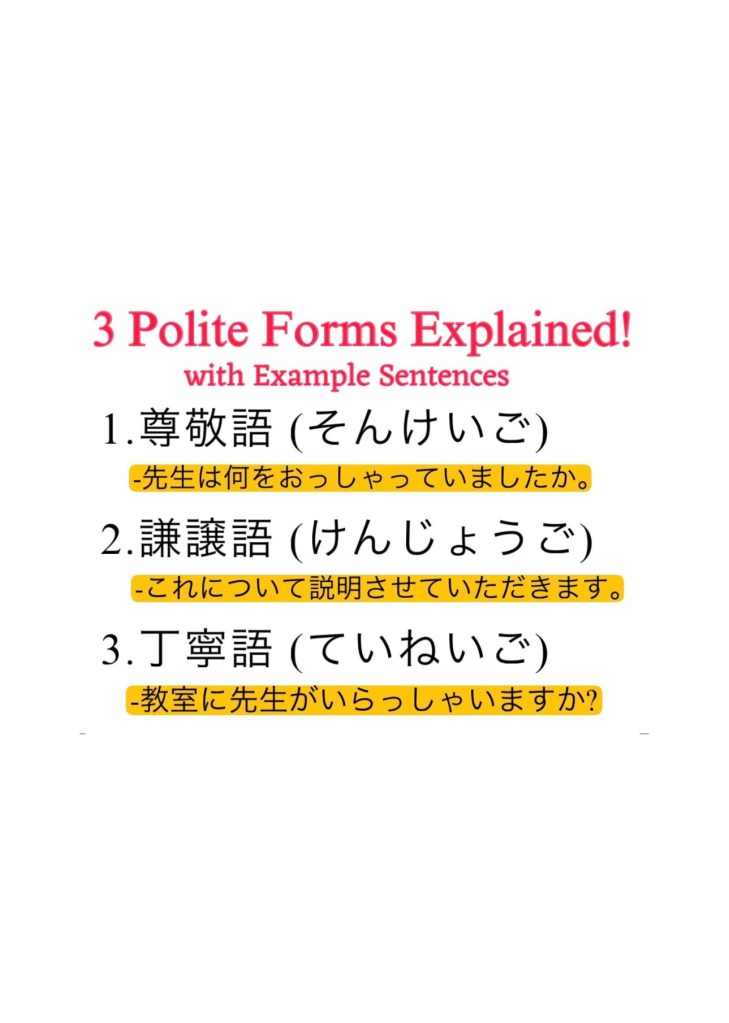
In this post, I will provide an explanation and overview of 尊敬語 (そんけいご), 謙譲語 ( けんじょうご) and 丁寧語(ていねいご). These all important categories of Japanese honorific language that play a key role in polite and respectful communication.
All are honorifics used to respect the other person.
First, I will explain 尊敬語 (sonkeigo) / そんけいご with example sentences to help you understand its usage.
1.尊敬語 (Sonkeigo) / そんけいご。
そんけいご is a type of honorific language in Japanese. It is used to show respect for the actions of others, especially people who are older, higher in status, or not close to you.
While using そんけいご , You raise other peoples and lowering yourself in a polite manner.
When you use そんけいご、 you replace regular verbs with special respectful verbs. This makes your Japanese sound more polite and professional.
For example:
- Normal: 社長が 来る (The president comes)
- そんけいご: 社長が いらっしゃる (The president comes – respectfully)
尊敬語 is commonly used in business, customer service, and formal situations. Learning it will help you speak naturally and respectfully in Japanese.
Example Sentences
社長
はいらっしゃいました。
The company president came (honorific).
先生
はそれをご覧
になりました。
The teacher saw that (honorific).
部長
はその仕事
をなさいます。
The manager will do that task.
先生
は私
の作文
をご覧
になりました。
The teacher looked at my essay.
社長
は「ありがとう」とおっしゃいました。
The president said “Thank you.
社長
は昼
ご飯
を召
し上
がりました。
The president ate lunch.
先生
はそのことをご存知
です。
The teacher knows about that.
社長
はそんなことはご存知
だと思
います.
I think the president knows that.
店長
は新
しい商品
についてご存知
です。
The store manager knows about the new product.
部長
はそのルールをご存知
です。
The department manager knows that rule.
店長
はそのニュースをご存知
でした。。
The store manager knew that news.
部長
はその情報
をご存知
でした。
The manager knew that information.
先生
は昔
からその問題
をご存知
でした。
The teacher had known about that problem for a long time.
社長
はその状況
をご存知
でした。
The president was aware of the situation.
部長
はすぐにその結果
をご存知
になるでしょう。
The department manager will probably find out the result soon.
店長
は来週
までにその変更
をご存知
になると思
います。
I think the store manager will know about the change by next week.
社長
はまだその問題
をご存知
ではありません。
The president doesn’t know about that problem yet.
部長
はその計画
をご存知
ではありません。
The manager doesn’t know that plan.
店長
はそのルールをご存知
ではありませんでした。
The store manager didn’t know the rule.
先生
はその出来事
をご存知
ではありませんでした。
The teacher didn’t know about the event.
先生
は「静
かにしてください」とおっしゃいます。
The teacher says, “Please be quiet.
社長
は毎朝
「おはよう」とおっしゃいます。
The president says “Good morning” every morning.
部長
は会議
で「頑張
りましょう」とおっしゃいました。
The manager said “Let’s do our best” in the meeting.
店長
は「これは大事
な仕事
です」とおっしゃいました。
The store manager said, “This is important work.
先生
は明日
のテストについておっしゃるでしょう。
The teacher will probably talk about tomorrow’s test.
部長
はあとで詳
しくおっしゃると思
います。
I think the manager will explain in more detail later.
先生
は何
もおっしゃいません。
The teacher doesn’t say anything.
社長
はその件
についてはおっしゃいませんでした。
The president didn’t say anything about that matter.
先生
は何
とおっしゃいましたか?
What did the teacher say?
社長
はこの件
についてどうおっしゃいますか?
What does the president say about this matter?
社長
がそうおっしゃっていました。
The president was saying that.
先生
がそうおっしゃっていたので、私
はそうしました。
Since the teacher said so, I did it that way.
社長
は新
しい資料
をご覧
になります。
The president looks at the new documents.
先生
はそのメールをご覧
になりません。
The teacher will not look at that email.
部長
はこの資料
をご覧
になりませんでした。
The manager didn’t look at this document.
先生
はこの本
をご覧
になりましたか?
Did the teacher look at this book?
社長
は資料
をご覧
になりますか?
Will the president look at the documents?
先生
は今
、私
のノートをご覧
になっています。
The teacher is looking at my notebook now.
部長
はそのぺーじをご覧
になっていました。
The manager was looking at that page.
もう一度
おっしゃってください。
もう一度
ご説明
いただけますか。
もう一度
お話
しいただけますか。
please say it again
社長
は毎朝
運動
をなさいます。
The president exercises every morning.
社長
は明日
の会議
でご説明
なさいます。
The president will give an explanation at tomorrow’s meeting.
お客様
は先
ほどお支払
いなさいました。
The customer made the payment a little while ago.
部長
は今
、お電話
をなさっています。
The manager is on the phone right now.
社長
はそのとき、重要
な話
をなさっていました。
The president was discussing something important at that time.
先生
は決
して手
を抜
きなさらない。
The teacher never cuts corners.
社長
はその件
について何
もおっしゃらなかったし、何
もなさらなかった。
The president neither said anything about it nor did anything.
社長
は今
おふぃすにいらっしゃいます。
The president is in the office now.
明日
の会議
に山田
部長
もいらっしゃいます。
Manager Yamada will also attend tomorrow’s meeting.
昨日
、お客様
がいらっしゃいました。
The customer came yesterday.
先週
、先生
がこちらにいらっしゃいました。
The teacher came here last week.
田中
先生
は今
、教室
にいらっしゃっています。
Professor Tanaka is currently in the classroom.
昨日
、社長
は会場
にいらっしゃっていました。
The president was at the venue yesterday.
田中
さんは今
、オフィスにいらっしゃいません。
Mr. Tanaka is not in the office right now。
会議
に部長
はいらっしゃいませんでした。
The manager did not attend the meeting.
今
何
の仕事
なさっていますか?
What work are you doing now?
山田
先生
は東京
へいらっしゃったことがありますか?
Has Professor Yamada ever been to Tokyo?
田中
先生
は新
しい映画
をご覧
になりましたか?
Has Professor Tanaka seen the new movie?
先生
さっき何
とおっしゃっていましたか?
Teacher, what did you say just now?
社長
はもう帰
えられましたか?
Has the president returned yet?
部長
日本
についてどう思
われますか?
Manager, what do you think about Japan?
もうお決
まりになりましたか?
Have you decided yet?
もうお決
まりですか?
Have you decided yet?
どうぞおかけください。
Please have a seat.
どうぞお座
りください。
Please have a seat.
どうぞお入
りください。
Please come in.
どうぞご自由
にお取
りください。
Please feel free to take some.
ぜひご検討ください。
Please consider it。
ご検討
いただけますと幸
いです。
We would appreciate your consideration.
ご検討
のほど、よろしくお願
いいたします。
We would appreciate your kind consideration.
また何
かご質問
があればご連絡
ください。
If you have any further questions, please contact us.
また何
かございましたら、お越
しくださいませ。
If you need anything else, please come.
また何
かございましたら、いらっしゃってください。
If you need anything else, please come.
何
かございましたらご来店
いただければなと思
います。
I hope you’ll come visit us if you need anything.
こちらのアンケートにご協力
いただけますか。
Would you like to participate in this survey?
恐
れ入
りますが、こちらのアンケートにご協力
いただけますでしょうか。
We would appreciate your cooperation in completing this survey.
お手数
ですが、アンケートへのご協力
をお願
いいたします。
We would appreciate your cooperation in filling out this survey.
こちらのアンケートにご協力
いただけますと幸
いです。
We would appreciate your cooperation in filling out this survey.
本日
本人
確認
書類
をお持
ちですか?
Do you have your identity verification documents with you today?
このすまほについてどうお考
えですか?
What do you think about this smartphone?
こちらのスマートフォンについて、どのようにお考
えでしょうか。
What do you think about this smartphone?
このスマートフォンに関
して、ご意見
をお聞
かせいただけますでしょうか。
Could you please let us know your thoughts on this smartphone?
お客様
はコーヒーを召
し上
がりましたか?
Did the customer drink the coffee?
先生
は朝
ごはんを召
し上
がりましたか?
Did the teacher have breakfast?
どうぞ、お茶を召し上がってください。
Please, have some tea.
どうぞ、お茶
をお召
し上
がりください。
Please enjoy your tea.
いえいえ、大丈夫
ですよ。
No, no, it’s okay.
いえいえ、大
したことないですよ。
No no, it’s no big deal.
こちらのぶらんどのスマートフォンをご利用
になったことはございますか。
Have you ever used a smart phone from this brand?
このぶらんどのスマートフォンをお使
いになったことはございますか。
Have you ever used a smart phone from this brand?
スマートフォンの状態
をお見
せいただけますか?
Could you please show us the condition of your smartphone?
この中
からお選
びください。
Please choose from the following.
よろしければ、この中
からお選
びいただけますか。
If you don’t mind, could you please choose from these?
何
かご意見
やご質問
がございましたら、お申
し付
けください。
If you have any comments or questions, please let us know.
何
かご意見
やご質問
がございましたら、どうぞお知
らせくださいませ。
If you have any comments or questions, please let us know.
ご意見
・ご質問
がございましたら、遠慮
なくお申
し出
ください。
If you have any comments or questions, please feel free to let us know.
どうぞお先
にお進
みください。
Please go ahead (before me).
こちらの説明
を聞
いて、イメージしていただきたいです。
I would like you to imagine this explanation.
新
しいサービスの使
い方
をイメージしていただきたいと思
います。
I hope you can imagine how to use the new service.
商品
がどのように動
くか、イメージしていただけますか?
Can you imagine how the product works?
2. 謙譲語 (Kenjōgo) / けんじょうご。
謙譲語 (kenjōgo), or humble language, While 尊敬語 (sonkeigo) raises the status of the person you’re talking about, 謙譲語 lowers your own position in order to show respect to the listener or subject.
While using けんじょうご、You lower yourself and other peoples will rise automatically.
In other words, you use 謙譲語 to humble yourself , making the other person feel respected. It’s commonly used in business, customer service, and formal situations.
For example:
普通
: 見
ます (tosee)
謙譲語
: 拝見
します(Ihumbly see/look)
スマートフォンの状態
を拝見
してもよろしいでしょうか?
May I have a look at the condition of your smartphone?
スマートフォンの状態
を確認
させていただけますでしょうか?
Could you please let me check the status of your smartphone?
すぐに担当者
をお呼
びします。
I will call the person in charge right away.
少々
お待
ちいただければ、先生
をお呼
びいたします。
If you could wait a moment, I will call the teacher.
社長
をお呼
びしますので、こちらでお待
ちください。
I will call the president, so please wait here.
必要
であれば、こちらからお医者
様
をお呼
びいたします。
If necessary, we will call a doctor for you.
ご案内
いたしますので、こちらへどうぞ。
I will guide you, so please come this way.
先生
にご挨拶
に伺
いました。
I visited the teacher to greet them.
→「行
きます」→謙譲語
「伺
います」
本日
、資料
をお渡
しいたしました。
I humbly handed over the documents today.
→「渡
します」→謙譲語
「お渡
しいたします」
後
ほど改
めてご連絡
いたします。
I will contact you again later.
→「連絡
します」→謙譲語
「ご連絡
いたします」
ただいま席
を外
しております。
He/She is currently away from their seat – humble way to explain your colleague’s situation.
→「しています」 → 謙譲語「しております」
ご質問
に関
して、確認
の上
ご返答
いたします。
I will respond to your question after confirming.
→「返答
します」→謙譲語
「ご返答
いたします」
先
ほどお電話
を差
し上
げましたが、ご不在
でした。
I called you earlier, but you were unavailable.
「電話
します」→謙譲語
「お電話
を差
し上
げます」
上司
に報告
させていただきます。
I will report to my supervisor.
後
ほどこちらに参
ります.
I will come here later.
ご指定
の時間
に参
ります.
I will come at the time you specified.
明日
、会議
に参
りますので、よろしくお願
いいたします。
I will attend the meeting tomorrow, so thank you in advance.
明日
、先生
の研究室
に伺
います。
I will visit your office tomorrow, Professor.
ご都合
のよい時間
に伺
わせていただきます。
I will come at a convenient time for you.
来週
、担当者
が御社
に伺
います。
Next week, our representative will visit your company.
一
点
、お伺
いしてもよろしいでしょうか?
May I ask you one question?
ご意見
をお聞
きしたいのですが、よろしいでしょうか。
I would like to ask your opinion, if that’s alright.
後
ほど詳
しくお伺
いします。
I will ask you in more detail later.
契約
内容
を確認
させていただきます。
I will check the contract details.
もういちどスケジュールを確認
させていただきます。
I’ll double-check the schedule.
このスマートフォンの状態
を見
させていただきます。
I will take a look at the condition of this smartphone – with respect.
商品
を見
させていただいてもよろしいですか?
May I take a look at the product?
先
に見
させていただきましたが、とても素晴
らしい内容
でした。
I had a chance to see it earlier and it was fantastic.
資料
を拝見
しました。
I have looked at the documents.
その写真
、拝見
してもよろしいでしょうか。
May I take a look at that photo?
その書類
を拝見
してもよろしいでしょうか?
May I take a look at that document?
先生
の論文
を拝見
しました。とても勉強
になりました。
I read your paper, professor. It was very educational.
心
よりお礼
を申
し上
げます。
I humbly express my sincere thanks.
お忙
しいところ、失礼
を申
し上
げました。
I humbly apologize for disturbing you while you were busy.
ご連絡
が遅
れましたことをお詫
び申
し上
げます。
I sincerely apologize for the delay in contacting you.
新年
のご挨拶
を申
し上
げます。
I offer my New Year’s greetings.
ご報告
申
し上
げます。
I would like to report to you — humbly.
今
から昼
ご飯
をいただきます。
I will eat lunch now.
ごちそうをいただき、ありがとうございます。
Thank you for the meal I am about to eat.
お食事
をいただいてもよろしいでしょうか。
May I have the meal?
先生
から本
をいただきました。
I received a book from the teacher.
ご丁寧
なお返事
をいただき、ありがとうございます。
Thank you for your polite reply.
ご意見
をいただければ幸
いです。
I would appreciate it if you could share your opinion.
ご連絡先
を頂戴
してもよろしいでしょうか。
May I have your contact information?
こちらの資料
を頂戴
いたしました。
I have received this document.
貴重
なお時間
を頂戴
し、誠
にありがとうございます。
Thank you sincerely for giving me your valuable time.
お茶
をいただいてもよろしいでしょうか。
May I have some tea?
お飲
み物
をいただき、ありがとうございました。
Thank you very much for the drink.
皆様
とご一緒
に乾杯
のお酒
をいただきます。
I will join everyone in drinking a toast — humbly.
この資料
を先生
に差
し上
げました。
I gave these materials to the teacher — humbly.
心
ばかりの品
ですが、どうぞ差
し上
げます。
It’s just a small gift, but please accept it.
後
ほど、改
めてご連絡
を差
し上
げます。
I will contact you again later — humbly.
ご説明
を差
し上
げますので、少々
お待
ちください。
I will give you an explanation, so please wait a moment.
お手伝
いを差
し上
げましょうか?
May I offer my help?
やまださまのことは、以前
より存
じ上
げております。。
I have known about Mr./Ms. YAMADA for some time.
その件
につきましては、よく存
じ上
げております。
I am well aware of that matter.
お名前
は存
じ上
げておりますが、お会
いするのは初
めてです。
I know your name, but it’s the first time we’ve met.
その方
のご経歴
については存
じ上
げております。
I am aware of that person’s background.
来週
の会議
でお目
にかかれるのを楽
しみにしております。
I’m looking forward to meeting you at next week’s meeting.
本日
はお忙
しいところ、お目
にかかれて光栄
です。
It’s an honor to meet you today despite your busy schedule.
明日
、担当
の方
にお会
いする予定
です。
I’m scheduled to meet the person in charge tomorrow.
社長
に直接
お会
いしてご挨拶
させていただきました。
I met the president in person and greeted them.
大阪大学
からやって参
りました、田中
と申
します。
I have come from Osaka University. My name is Tanaka.
これから商品
の特徴
について説明
させていただきます。
I will now explain the features of the product.
少
しお時間
をいただきまして、説明
させていただきます。
Please allow me a moment to explain.
ご不明
な点
がありましたら、説明
させていただきますのでお知
らせください。
If you have any questions, please let me know, and I will explain.
一
年
のかけてりべんじをさせていただきました.
It took me a year to get my revenge.
皆様
の前
でしゃべりさせていただいています。
I am humbly speaking in front of everyone.
今
、会議
でしゃべりさせていただいています。
I am currently speaking in the meeting.
今回
のご提案
について、じっくり考
えさせていただきました。
I have carefully considered your proposal.
お金
を稼
がせていただきました。
I was allowed to earn money.
お仕事
をさせていただき、収入
を得
ました。
I was able to work and earn income.
少
しだけお時間
をいただき、話
させていただきます。
Please allow me a moment to speak.
会議
で意見
を話
させていただきたいと思
います。
I would like to speak my opinion at the meeting.
詳細
については、すでにお伝
えさせていただきました。
I have already conveyed the details.
上司
にご報告
をお伝
えさせていただきました。
I have reported to my superior.
何
かお困
りのことがあれば、お手伝
いをさせていただきたいと思
います。
If you have any difficulties, I would like to assist you.
プロジェクトとの成功
のために、お手伝
いをさせていただきたいです。
I would like to help for the success of the project.
お忙
しい時
は、ぜひお手伝
いをさせていただきたいと思
います。
When you are busy, I would be happy to assist.
必要
な道具
を持
ってこさせていただきましたので、ご確認
ください。
I have brought the necessary tools, so please check.
3.丁寧語 /ていねいご(Teineigo)
丁寧語/ていねいご is one of the three main types of Japanese honorific language. It is used to speak politely, regardless of the social status of the listener. 丁寧語/ていねいご is commonly used in everyday situations such as customer service, workplaces, schools, or when speaking to someone you don’t know well. It’s most often recognized by the use of 「です」「ます」 and polite words like 「ございます」.
It is a respectful way of speaking that helps communication go smoothly, especially in professional or unfamiliar situations. By using polite forms, you show consideration and build good relationships, without lowering your own value or overly elevating the other person.
Using 丁寧語 /ていねいご helps you sound respectful and professional without being too formal or distant.
Polite language is not about putting yourself down or raising the other person too high, You just telling something politely.
Example Sentences :
こちらは最新
のカタログでございます。
This is the latest catalog.
こちらは社長
でいらっしゃいます。
This is the company president.
田中
様
はお忙
しいでいらっしゃいますか?
Is Mr. Tanaka busy?
先生
でいらっしゃいますので、ぜひご挨拶
させていただきます。
Since you are a teacher, I would like to greet you.
こちらに資料
がございます。
Here are the materials.
ご質問
がございましたら、お知
らせください。
If you have any questions, please let us know.
お席
がまだございます。
There are still seats available.
当店
に新
商品
が多数
ございます。
We have many new products in our store.
この件
についてご存
じの方
はいらっしゃいますか?
Is there anyone who knows about this matter?
どなたか、この問題
をご存
じの方
はいらっしゃいますでしょうか?
Is there anyone who might know about this issue?
ご存
じの方
がいらっしゃいましたら、教
えていただけますか?
If there is anyone who knows, could you please tell me?
この情報
をご存
じの方
はいらっしゃいますか?
Is there anyone who knows this information?
ご質問はございませんか?
Do you have any questions?
追加の資料はございますか?
Do you have any additional documents?
Conclusion
while talking Japanese Language, using 尊敬語/そんけいご (respectful language), 謙譲語 /けんじょうご(humble language), and 丁寧語 /ていねいご(polite language) correctly is very important for showing respect and speaking appropriately in different situations.
At first, these forms may seem difficult, but with regular practice, you will become more comfortable using them.
Please take your time and keep learning step by step.
Thank you very much for reading.
Do Comment and Subscribe for more informative post ! がんばりましょう。
 Nihongo Focus
Leave a comment