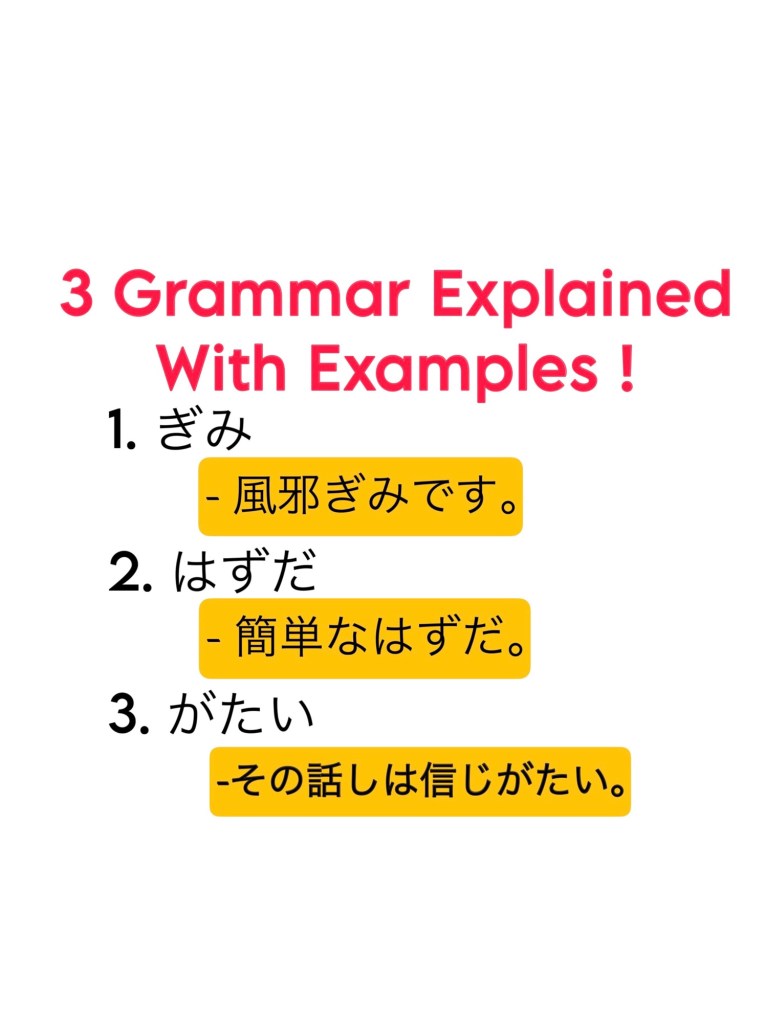
In this lesson, we’ll learn three useful Japanese grammar points that often appear in daily life, conversation, and writing: ぎみ, はずだ, and がたい. These expressions help you describe feelings, logical expectations, and difficult actions in a natural and fluent way. Each one has a different meaning and usage, but they are all easy to understand with some practice. Let’s take a look at how they work with simple explanations and examples!
1.ぎみ (gimi): -like, -looking
Meaning: -like, -looking
ぎみ is used when you feel a little bit of something. It’s often used with negative feelings like being tired, sick, or nervous.
Formation:
Noun + 気味
Verb-stem + 気味
Example sentences:
風邪
ぎみです。
I feel like I’m catching a cold.
緊張
ぎみでした。
I’m kind of forgetful lately.
緊張ぎみでした。
I was a little nervous.
2時間
も字
を打
ったので、ちょっと疲
れ気味
です。
I typed non-stop for 2 hours so I’m a little tired.
新入
社員
は緊張気味
の顔
をしていた。
The new employees looked nervous.
残業続
きで疲
れ気味
だ。
I’ve been feeling tired because of continuous overtime work.
今日
はどうも風邪気味
で、頭
が痛
い。
Today I caught a cold so I have a headache.
生活
が不規則
で睡眠
不足気味
だ。
I’m lack of sleep because I’ve been keeping irrergular hours.
最近
太
り気味
なので、夕食
を抜
くことにした。
Since I’m getting fat, I decided to skip dinner.
初
めての演説
なので、彼
は少
し緊張気味
だ。
Since it’s his time giving a speech, he’s a little nervous.
………
2.はずだ (hazu da): it must be, it should be
Meaning: it must be, it should be
はずだ is used when you expect something to be true based on logic, information, or what you know. It shows your belief that something is supposed to happen or be a certain way.
Formation:
Verb-casual + はずだ
いadjective + はずだ
なadjective + なはずだ
Noun + のはずだ
Example sentences:
彼
は日本
に住
んでいるから、日本語
が話
せるはずだ。
He lives in Japan, so he must be able to speak Japanese.
今
は春
だから、寒
くないはずだ。
It’s spring now, so it shouldn’t be cold.
これは簡単
なはずです。
This should be easy.
寒
いはずです。雪
が降
ってきました。
It must be cold. It started snowing.
このブランドバッグは50万
円
以上
かかるはずだ。
This brand bag must cost more than 500.000 yen.
今日
は祝日
だから、会社
は休
みのはずだ。
Today is a national holiday so the company should be closed.
今日
は日曜日
だからでぱーとはこんでいるはずです。
Today is Sunday so the department store must be crowded.
パパがそろそろ家
に帰
るはずだ。
Daddy should be home soon.
………
3.がたい (gatai): hard to, difficult to
Meaning: hard to, difficult to
がたい is used to say something is difficult or almost impossible to do, especially when it involves emotions, understanding, or accepting something. It is often used in formal or written Japanese.
Formation:
Verb-masu stem + がたい
Example sentences:
その話
は信
じがたい。
That story is hard to believe.
忘
れがたい思
い出
です。
It’s an unforgettable memory.
(Literally: A memory that is hard to forget)
彼
の行動
は許
しがたい。
His actions are hard to forgive.
あの家
はいまや形容
しがたいほどに汚
れている。
That house is so dirty that it’s hard to even describe it.
彼
の話
は信
じがたい内容
だった。
His story was unbelievable.
女性
の考
え方
には、我々
男性
には理解
しがたいことがある。
It’s hard for us men to understand some women’s ways of thinking.
幼
い子供
に対
する犯罪
は許
しがたい。
Crimes against children are unforgivable.
信
じがたい事
かもしれませんが、うちの息子
は20ヶ国語
も話
せます。
You might not believe this, but my son can speak 20 languages.
その計画
は成功
したとは言
いがたい。
It’s hard to say that the plan was a success.
二
人
の顔
に浮
かんだ憎
しみは、甲乙
つけがたい激
しさだった。
The hatred on their faces was so fierce that it’s hard to say which of them hates the other one more.
Summary
Now you’ve learned how to use ぎみ, はずだ, and がたい in simple and natural ways. These grammar points are useful for expressing subtle feelings, logical expectations, and things that are hard to do. Try using them in your own sentences to get more comfortable. Keep practicing, and your Japanese will keep getting better step by step!
Do Comment and Subscribe for more informative posts. がんばりましょう。
 Nihongo Focus
Leave a comment