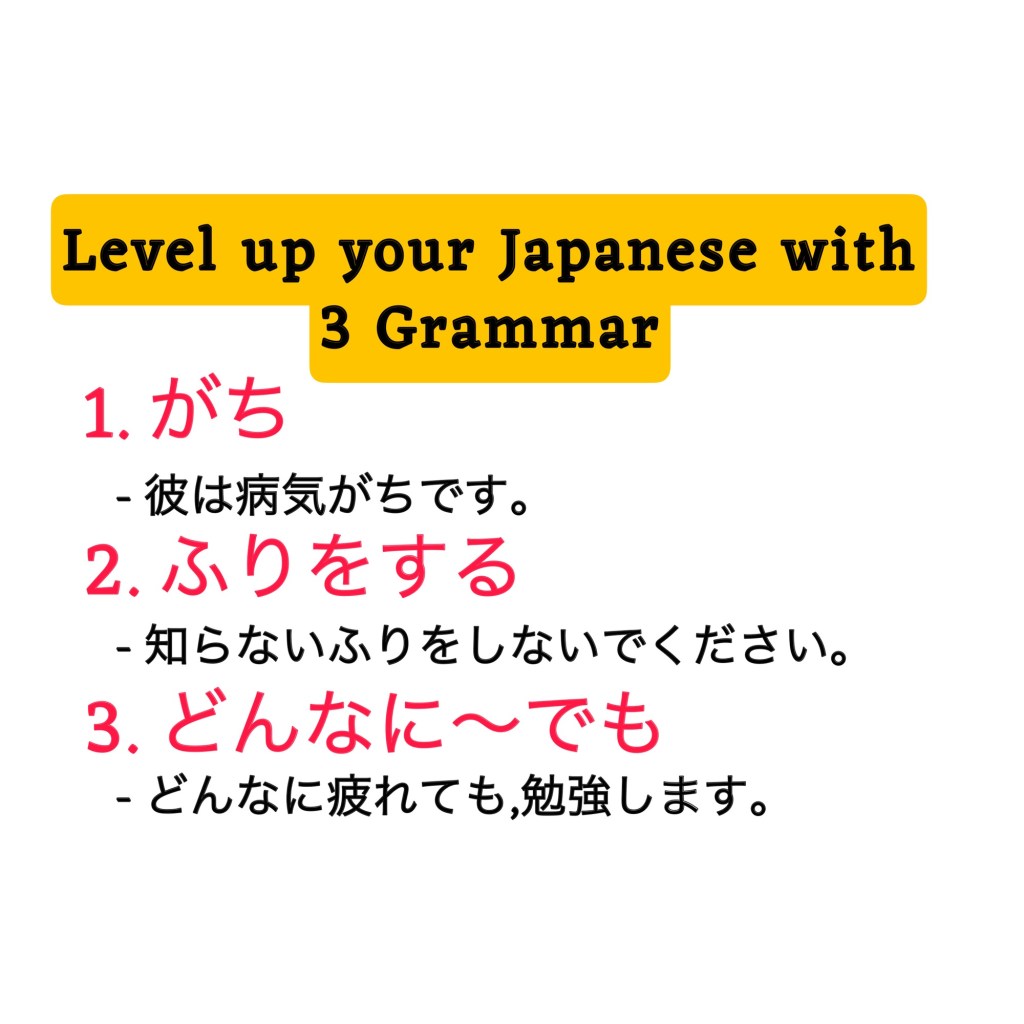
In this post, we will learn three useful Japanese grammar patterns that you can use in everyday conversation. These are:
- がち (gachi) – Used when something happens often, usually in a negative way.
- ふりをする (furi o suru) – Used when someone pretends or acts like they are doing something.
- どんなに〜ても (donna ni ~ temo) – Used to say “no matter how” something is, the result stays the same.
Each of these grammar points helps you express more natural and deeper meanings in Japanese. Let’s look at how to use them with simple examples!
1.がち (gachi): apt to do, tend to do
This grammar is used when something happens too often or is a bad habit.
がち is used when something happens often or you do something a lot. It is usually used for something not so good.
Formation:
Verb-stem + がちだ
Noun + がちだ
How to use:
Example sentences:
病気
がちです.
I often get sick.
忘
れがちです。
I often forget things.
雪
が降
ると、電車
は遅
れがちだ。
The trains are usually late when it snows.
先日
、病気
がちのおばを見舞
いに行
った。
I came to visit my sick aunt yesterday.
結婚
して何
十
年
もたつと、結婚
記念日
さえ忘
れがちになる。
You tend to forget your anniversary after many years of being married.
何
度
も失敗
をすると、また失敗
をするのではないかと考
えがちになる。
After you’ve failed many times, you tend to think whether you’re gonna fail again if you try.
「写真
を撮
ってもいいですか?」カメラを持
ち上
げて、彼
が遠慮
がちに頼
んだ。
“Can I take a picture?” He held the camera up and asked hesitantly.
そういう事故
はとかく起
こりがちです。
That kind of accident happens quite often.
彼
は最近
、体調
を崩
して、学校
を休
みがちです。
He hasn’t been to school lately due to his sickness.
2.ふりをする (furi o suru): to pretend, to act as if
This grammar is used when someone is not really doing something, but acts like they are.
ふりをする means to pretend or act like you are doing something, even if you’re not really doing it.
Formation:
Verb(casual/plain form) + ふりをする
Noun + のふりをする
いadj + ふりをする
なadj + なふりをする
Example sentences:
知
らないふりをしました。
I pretended not to know.
元気
なふりをする。
Pretend to be fine.
勉強
しているふりをする。
Pretend to be studying.
「いやだ!」しゃくりあげるふりをしながら彼女
がわめいた。
I don’t wanna!” She screamed while pretending to sob convulsively.
彼女
は聞
こえないふりをした。
She pretended not to hear.
中田
さんは独身
のふりをしているが、結婚
していて3人
も子供
がいる。
Tanaka looks like a single guy but in fact he’s married with three children.
彼
は何
かを探
すふりをした。
He pretended to look for something.
ケーキがまずかったけれど、ふたり(二人)もおいしそうなふりをした。
Although the cake tasted horrible, the two of them pretended that it was good.
彼
はそのことについて知
っているふりをしているが、本当
は知
らないと思
う。
He pretends to know about it but I don’t think he really does.
木村
さんは息子
などいないというふりをしていた。
Kimura acts like he doesn’t have a son.
女
の子
が寝
ているふりをしていた。
The little girl pretended to sleep.
おじさんが新聞
を立
てて開
いて読
むふりをした。
My uncle opened the newspaper and pretended to read it.
3.どんなに~ても (donna ni ~ temo): no matter how
This grammar is used to show strong will or that something will happen even in a hard situation.
どんなに〜ても is used to say “no matter how” something is. It shows that even if something is very strong or big, the result doesn’t change.
Meaning: no matter how
Formation:
どんなに+ Verb-てform + も
どんなに + Noun + でも
どんなに+ adj + (-い) くても
どんなに+なadj + でも
Example sentences:
どんなに疲
れても、勉強
します。
No matter how tired I am, I will study.
どんなに高
くても、買
います。
No matter how expensive it is, I will buy it.
わたしは、いくらお酒
を飲
んでも顔色
が変
わらない。
My face doesn’t turn red no matter how much I drink.
どんなに一生懸命
働
いても、生活
は楽
にならないだろうと思
う。
No matter how hard I work, I don’t think my life will get any easier.
どんなに健康
に自信
があっても、油断
していると風邪
を引
く。
No matter how healthy you think you are, you’ll catch a cold if you get careless.
わたしはどんなに暑
くても寝
るときはくーら一
を消
して寝
ます。
No matter how hot it is, I always turn off the air-conditioner when I go to bed.
父
はどんなに苦
しくてもあきらめませんでした。
My father didn’t give up no matter how hard it was.
もう酒
は飲
まないと決
めた以上
は、どんなに誘
われても絶対
にそれを守
りたい。
Because I have already decided to quit drinking, I won’t drink no matter how much you insist.
ギターを習
い始
めたが、どんなに練習
しても全然
うまくならない。
I’ve started taking guitar lessons but I’m not getting any better no matter how much I practice.
どんなに頑張
っても、50点
しかとれなかった。
No matter how hard I tried, I never got more than 50 points.
In this post, we learned three useful Japanese grammar points:
- がち – to talk about something that happens often (usually not good).
- ふりをする – to say someone is pretending.
- どんなに〜ても – to show that something stays the same, no matter what.
These patterns are great for expressing more natural feelings and situations in Japanese. Try using them in your daily conversation or writing to get better at Japanese!
Thank you for reading, and keep practicing!
Do Comment and Subscribe for the more informative post !
がんばってください!😊
 Nihongo Focus
Leave a comment