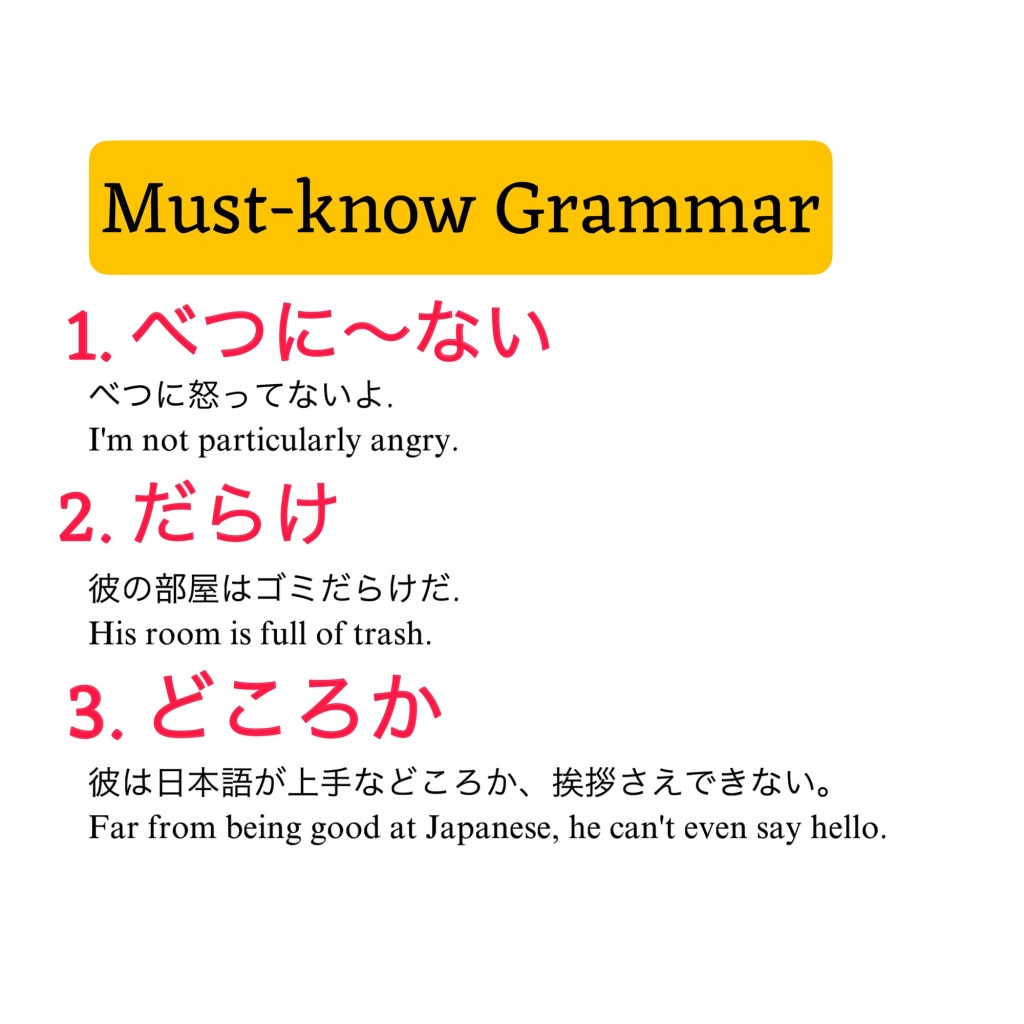
In this post, we’ll take a look at three common grammar patterns: “べつに〜ない,” “だらけ,” and “どころか.” Let’s learn their meanings and usage with simple explanations and examples !
- べつに〜ない (betsu ni ~ nai): not really, not particularly
This expression is used to show that something is not especially true or that the speaker doesn’t feel strongly about something. It’s often used in casual conversation, especially when someone wants to deny interest, emotion, or intention.
Meaning: not really, not particularl
Formation:
別に+ Verb-ないform
別に+ Noun +ではない
別に + いadj (remove い) + くない
別に+なadj +ではない
Example sentences:
別
にそれほど疲
れていません。
I’m not really that tired.
わたしは別
に彼女
が大嫌
いなわけではありませんよ。
It’s not that I really detest her.
彼
は僕
の失礼
な言葉
を別
に気
にする様子
もない。
He doesn’t look like he cares about my rude remarks.
別
に彼
のために作
ったわけではない。
It’s not like I made this for him.
その絵
は別
に貴重
なものでもなんでもないです。
That painting is not really valuable.
別
にかまわないよ。
I don’t really care.
お金
をたくさん持
ってることは別
に怪
しくないでしょ。
Carrying a lot of money isn’t suspicious, is it?
2. だらけ (darake): covered all over in, full of
The expression だらけ is used to indicate that something is full of or covered with something — usually something unpleasant, undesirable, or excessive.
Meaning: covered all over in, full of
Formation:
Noun + だらけ
Example sentences:
身
も心
も傷
だらけの彼
は最後
自
ら自分
の命
を絶
ったのです。
Being physically and mentally hurt, he ended up taking his own life.
彼
はそばかすだらけの顔
が青白
く見
えた。
His freckle face turned pale.
泥
だらけの靴
で家
に入
って怒
られた。
I entered the house with my full-of-dirt shoes on so I was scolded.
彼女
は学生
の間違
いだらけの作文
を家
へ持
ち帰
して、いちいち直
してやりました。
She brought the student’s essays that are full of errors home and corrected all of them.
部屋
の中
はおもちゃだらけで立
つところもありません。
The room is so full of toys that there’s no place to stand.
彼
の部屋
はごみだらけだ。
His room is filled with trash.
彼女
のべっどは包
み紙
だらけになっている。
Her bed is now covered in wrapping papers.
机
の上
にほこりだらけです。
The table is full of dust.
3.どころか (dokoro ka): far from, anything but
This grammar is used when the reality is very different from what was expected or mentioned — often the complete opposite. It’s like saying “far from that” or “not only that, but even worse/better.”
Meaning: far from, anything but, let alone, much less
Formation:
Verb-dictionary form + どころか
いadjective + どころか
なadjective + などころか
Noun + どころか
Example sentences:
忙
しいどころか、毎日
ひまです。
Far from being busy, I’m free every day.
暑
いどころか、寒
いです。
It’s not hot at all — it’s cold!
走
るどころか、歩
くのもできない。
I can’t even walk, let alone run.
勉強
したどころか、げーむばかりしていた。
Far from studying, I was just playing games.
忙しくて、休みをとるどころか、食事をする 時間もない。
I’m so busy that I don’t even have time to eat, let alone taking a day off.
私は彼に役に立つどころか、迷惑もかけた。
I not only didn’t help him, I also caused him trouble.
彼
は日本語
どころか、英語
も話
せません。
Far from speaking Japanese, he can’t even speak English.
雨
どころか、雪
が降
ってきた。
It wasn’t just rain — it even started snowing!
元気
どころか、病気
で寝
ています。
Far from being healthy, he’s sick in bed.
Now you’ve learned how to use the grammar points “べつに〜ない,” “だらけ,” and “どころか”! These are all useful expressions commonly used in everyday Japanese. Practice using them with example sentences, and you’ll sound more natural like a native speaker in no time!
Do Comment and Subscribe for more informative post ! がんばりましょう。


Leave a Reply