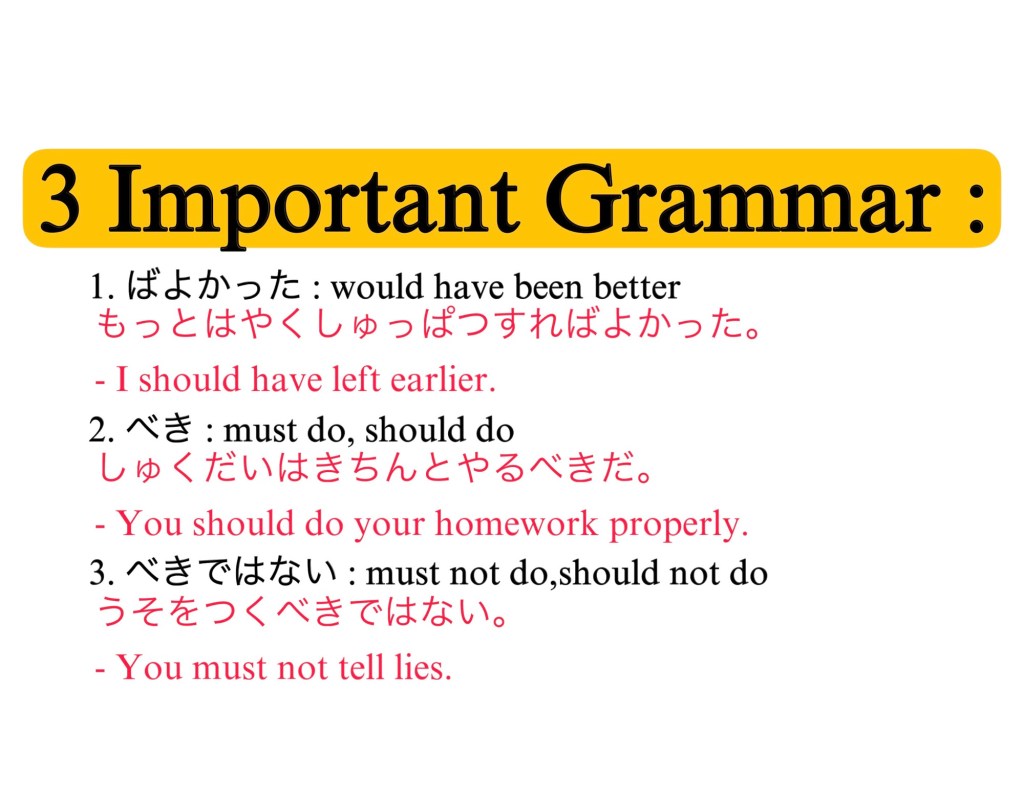
- ばよかった : should have, it would have been better if
Meaning: should have, it would have been better if..
Formation: Verb-ば conditional + よかった(のに)
“ばよかった (ba yokatta)” is a Japanese grammar structure that expresses regret or a sense that a past action or inaction was not the best choice. It carries the nuance of “should have done…” or “it would have been better if…”.
Here’s a breakdown of its components and how it works:
Verb (in the ば-conditional form): The verb is conjugated into its “ba-conditional” form. This form often implies a hypothetical or conditional situation. For example:
* 行
く( (iku – to go) becomes 行
けば (ikeba – if I go/went)
* 食
べる (taberu – to eat) becomes 食
べれば (tabereba – if I eat/ate)
* する (suru – to do) becomes すれば (sureba – if I do/did)
* 来
る (kuru – to come) becomes 来
れば (kureba – if I come/came)
* よかった (yokatta): This is the past tense of the adjective いい (ii – good). In this context, it signifies that the hypothetical situation described by the “ba-conditional” verb would have resulted in a better outcome.
Putting it together:
By combining the “ba-conditional” form of a verb with “よかった,” you create a sentence that expresses regret about a past situation. You’re essentially saying, “If only [past action/state] had been [different], things would have been better.”
Examples Sentences :
もっと勉強
すればよかった。
– I should have studied more. (It would have been better if I had studied more.)
早
く寝
ればよかった。 –
– I should have gone to bed earlier. (It would have been better if I had gone to bed earlier.)
傘
を持
っていけばよかった。
– I should have brought an umbrella. (It would have been better if I had brought an umbrella.)
あの時
、彼
に話
しかければよかった。
– I should have talked to him at that time. (It would have been better if I had talked to him at that time.)
朝
まで待
てばよかった。
-I should have waited until the morning.
遅刻
してしまった。もっと早
く家
を出
ればよかった。
–I went to school late. I should have left earlier.
漫画家
になればよかった。
–It’d have been better if I had become a manga artist.
わたしたちの手
でどあを開
ければよかったのですが、それを娘
にさせたのです。
–We should have opened the door by ourselves, but we let our daughter do it.
.早
く連絡
してくれればよかったのに。
–You should have contacted me earlier.
田中
さんにあんなことを言
わなければよかった。
–I shouldn’t have said such things to Tanaka.
傘
を持
ってくればよかった。
–Should have bought my umbrella.
ゆうべの番組
は面白
かった。
–The program last night was interesting. You should have seen it.
新
しいぱそこんを買
わないで、わたしのを使
えばよかったのに。
–You shouldn’t have bought a new computer and used mine instead.
2.べき (beki): must do, should do
Meaning: must do, should do
Formation: Verb-dictionary form + べき/べきだ
べき (beki)” is a Japanese grammar structure that expresses a strong sense of obligation, duty, or what is considered morally right or the natural course of action. It carries a stronger nuance than a simple suggestion and often implies a societal expectation, a logical necessity, or a personal conviction about what ought to be done. It translates to English as “should,” “must,” or “ought to.”
Here’s a breakdown of its usage:
Attaching to verbs: “べき” typically follows the dictionary form of a verb (辞書形- jishokei). For irregular verbs:
* する (suru – to do) becomes するべき (suru beki – should do, must do)
* くる (kuru – to come) becomes くるべき (kuru beki – should come, must come)
Example Sentences:
学生
はもっと勉強
すべきだ。
–Students should study more.
親
は子供
を守
るべきだ。
– Parents should protect their children.
成功
したいなら、努力
すべきだ。
– If you want to succeed, you should make an effort.
悪
いことをしたら、謝
るべきだ。
– If you do something bad, you should apologize.
学生
はもっと勉強
す(る)べきだ。
–Students should study harder.
電車
の中
では、若者
は年寄
りに席
を譲
るべきです。
–Young people should give up their seats to the elderly on the train.
何
をすべきか、もう彼女
の心
は決
まっていた。
–She has already decided about what she must do.
わたしは彼
に言
うべきことを全部
言
った。
–I told him everything I should say.
彼
に会
いに行
くべきじゃないかな?
Shouldn’t we go to see him?
約束
は守
るべきだ。
–You should keep your promises.
人間
は自分
の行動
に責任
を持
つべきだ。
–People should take responsibility for their own actions.
拾
った財布
は警察
に届
けるべきですよ。
–You should hand over the wallet you picked up to the police.
おもちゃは、まず安全
であるべきだ.
–Safety comes first for toys.
3. べきではない (beki dewa nai): must not do, should not do
Meaning: must not do, should not do
Formation: Verb-dictionary form + べきではない
べきではない (beki dewa nai)” is the negative form of the Japanese grammar structure “べき (beki)”. It expresses a strong sense of prohibition, indicating that something must not be done or should not be done because it is considered wrong, inappropriate, against rules or norms, or logically undesirable. It carries the nuance of a strong negative obligation or a firm recommendation against a particular action. It translates to English as “must not,” “should not,” “ought not to,” or “it is not right to do.”
Example sentences:
嘘
をつくべきではない。
–You should not tell lies.
約束
を忘
れるべきではない。
–You should not forget your promises.
過去
を忘
れるべきではありません。
–You shouldn’t forget about your past.
そんなことをすべきではない。
–You shouldn’t do such a thing.
暴力
行為
はどんな理由
があっても絶対
に許
すべきではない。
–Acts of violence must not be forgiven for whatever reasons.
親
に対
してはこんな失礼
なことを言
うべきではありません。
–You should not say such rude things to your parents.
子供
の安全
を考
えれば、夜
遅
くまで外
で遊
ばせるべきではない。
–For your own children’s safety, you should not allow them to play outside late at night.
大学院
は自分
で研究
を進
めるところだから、先生
に頼
ろうとするべきではない。
–You should study by yourself in graduate school, not relying on your teacher.
なぜ、皆
、僕
が真実
を知
るべきではないと固
く決意
しているのだろうか?
Why does everyone keep insisting that I should not know the truth?
Conclusion:
Understanding how to say what you should do, shouldn’t do, and should have done is a big step toward expressing yourself naturally in Japanese. Grammar points like ばよかった, べき, and べきではない help you give advice, reflect on past actions, and talk about responsibility with confidence. Keep practicing these patterns in real situations, and you’ll sound more fluent and thoughtful in your Japanese conversations!
Do Comment and Subscribe for more informative post. がんばりましょう。


Leave a Reply