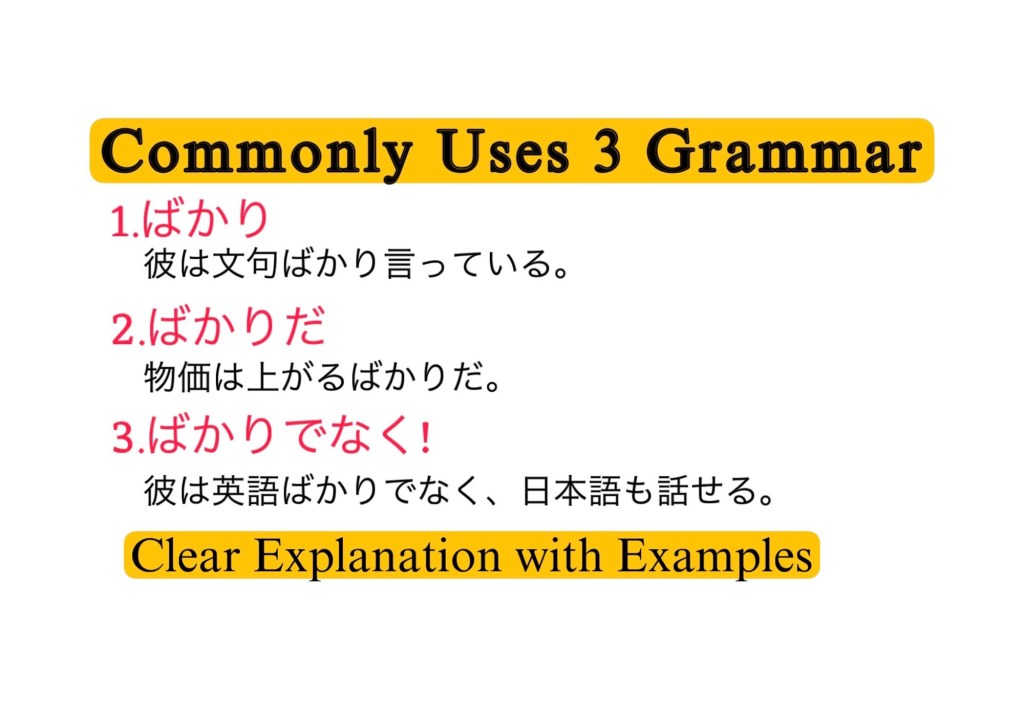
1.ばかり- only, Nothing but
The Japanese grammar point ばかり is used to express the meaning of “only” or “nothing but.” It emphasizes that something happens repeatedly or excessively, or that someone does nothing else but that action. It follows nouns or verb forms and often carries a slightly negative nuance, as if the speaker is surprised or frustrated.
Example Sentences :
あの子
はお菓子
ばかり食
べている.
That child eats nothing but sweets only.
あの子
は甘
いものばかり食
べます。
That child only eats sweet stuff.
主人
は小説
を読
んでいるばかりで、家事
を全然
手伝
ってくれない。。
My husband reads novels all day and doesn’t help me with housework at all.
テレビを見
てばかりいると、目
が悪
くなりますよ。
If you watch TV all the time your eyesight will get worse.
赤
ちゃんが泣
いてばかりいます。
The baby keeps crying.
この店
のお客
さんは、男性
ばかりですね。
There are only male customers in this store.
あの人
は背
が高
いばかりで、あまり力
はない。
That person is only tall, he’s not really strong.
嘘
ばかりつく人
が嫌
いだ。
I hate people who only tell lies.
うちの子
は毎日
遊
んでばかりで勉強
をしない。
My child doesn’t study at all, he just plays all day.
そんなに働
いてばかりいては体
を壊
しますよ。
You’ll collapse if you keep on working all the time like that.
子
どもの頃
は体
が弱
くて病気
ばかりしていました。
When I was a kid, I was weak and pretty sickly.
問題
を無視
することはできません。しかし、問題
にばかり注目
していると、過去
の状態
を取
り戻
そうと努力
することになります。
You can’t neglect problems, but if you focus exclusively on problems, you’re trying to restore yesterday.
この競争
ばかりのむなしい世界
から逃
れたい。。
I want to escape this empty world that’s full of competition.
20代
はこーらやお菓子
ばかりだったんですけど、今
は変
わりましたね。健康
管理
にも気
を使
うようになりました。
I only drank cola and ate sweets when I was in my 20s, but I’ve changed now. I’ve started taken care of my health.
今
でも連絡
を取
り合
っていますよ。つい先日
も会
いました。携帯
げーむの話
ばかりしていましたけど。そんな少年
のようなところも大
好
きです。
We’re still keeping in touch even now. I just met him the other day. We only talked about mobile games though. I like that boyish side of his.
タケシはふざけてばかりいるけど、仕事
ではぷろであり、心
の温
かい人
です。
Takeshi keeps joking around, but when he works he’s a pro and a kind-hearted man.
ボクシングの経験
があるので、監督
に、「ぱんちに自信
があります」とあぴーるしたんですけど、なぜかこのきゃらくたはきっくばかり。最初
は戸惑
いましたが、撮
ったしーんを見
るとすごく格好
よくて、なぜ監督
がきっくを選
んだのか分
かりました。。
I have experience in boxing, so I told the director that “I’m good at punching,” but somehow this character only kicked. I was perplexed at first, but when I saw how cool the scene was, I realized why the director chose kicking.
いつも問題
ばかり起
こす母親
によって傷
つけられた息子
でもある。
He’s also a son who’s always hurt by his trouble-making mother.
今日
はどうもおかしなことばかりあってなあ。ろんこのあたりには時々
変
なやつらがうろうろしてるにはしてるんだが。
There are some funny things going on today. Of course, we do get queer folk wandering in these parts at times.
友達
とお酒
を飲
んだりするときも音楽
の話
ばかりです。
I only talk about music when I go out to drink with my friends.
2. ばかりだ (bakari da): continue to
The grammar pattern ばかりだ is used to express that a situation is continuously proceeding in a negative direction or becoming worse over time. It often follows the plain form of verbs and emphasizes that something is happening more and more. This structure is commonly used with negative developments, such as increasing prices, worsening conditions, or growing problems.
Example Sentences :
物価
は上
がるばかりだ.
Prices just keep going up.
祖父
は体
が弱
っていくばかりだ。。
My grandfather’s body is getting weaker.
傷
が深
くなるばかりです。
The wound keeps getting deeper.
「教
えてよ!」わたしたちが促
したが彼
は笑
って首
を横
に振
るばかりだった。
“Tell us!”, we urged him but he just laughed and kept shaking his head.
手術
が終
わってから、父
の病気
は悪
くなるばかりでした。
After the surgery, my dad’s illness keeps getting worse.
資源
をめぐる争
いで、両国
の関係
はますます悪化
するばかりだ。。
Because of the dispute over resources, the two countries’ relation is worsening.
英語
も数学
も学校
を出
てからは忘
れていくばかりだ。
I’ve been forgetting English and Maths since graduating from high school.
彼女
は何
も言
わなかった。ただわたしを睨
むばかりだった.
She didn’t say anything. She kept glaring at me.
戦争
のために、国民
の生活
はますます苦
しくなるばかりだ。
Because of the war, people’s lives have been getting harder.
3. ばかりでなく (bakari denaku): not only… but also, as well as
The grammar pattern ばかりでなく means “not only… but also” or “as well as.” It is used to show that something is not limited to just one thing but includes others too. It connects two similar or related ideas and emphasizes that the second part is just as important as the first. This expression is often used in both formal writing and speech.
Using Patterns:
Verb-casual + ばかりか/ばかりでなく
Noun + ばかりか/ばかりでなく
いadj + ばかりか/ばかりでなく
なadj + なばかりか/ばかりでなく
Example Sentences:
彼
は日本語
を話
すばかりか、漢字
も書
けます。( Verb-casual )
He not only speaks Japanese but also can write kanji.
彼女
はピアノを弾
けるばかりでなく、作曲
もできます。( Verb-casual )
She not only plays the piano but also composes music.
この店
は味
が悪
いばかりか、さーびすも最悪
です。( いadj )
This restaurant not only has bad taste but also terrible service.
彼
は英語
ばかりでなく、日本語
も話
せます. (Noun)
He can speak not only English but also Japanese.
このアパートは狭
いばかりでなく、暗
いです。( いadj )
This apartment is not only small but also dark.
彼
は漢字
が書
けないばかりか、平仮名
も片
仮名
も書
けない。( Verb-casual )
He can’t even write hiragana or katakana, let alone the Kanji.
ピーターさんは日本
に行
くことは、友人
ばかりでなく、家族
でさえも知
りませんでした。(Noun)
Both Peter’s friends and family didn’t know that he’d go to Japan.
わたしは右手
ばかりでなく左手
でも字
が書
けます。(Noun)
I can use not only my right hand but also my left hand to write.
このごろ、彼
は遅刻
が多
いばかりか、授業中
に居眠
りすることもあります。( いadj )
Lately he only go to school late but also nod off during class.
この車
は空気
を汚
さないばかりか、価格
が高
い。( Verb-casual )
This car not only has poluted air, its price is also high.
山田
さんは医者
ばかりでなく、作家
としても有名
です。(Noun)
Mr. Yamada is not only a doctor but also well known as a writer.
この問題
は難
しいばかりか、時間
もかかります。( いadj )
This problem is not only difficult but also time-consuming.
この映画
は面白
いばかりでなく、感動的
でもあります。( いadj )
This movie is not only interesting but also moving.
彼
は親切
なばかりか、とても賢
いです。( なadj )
He is not only kind but also very smart.
この部屋
は静
かなばかりでなく、とても広
いです。 ( なadj )
This room is not only quiet but also very spacious.
ばかり, ばかりだ, and ばかりでなく are helpful grammar points in Japanese. Use ばかり when talking about “only” doing something, ばかりだ when something keeps happening or getting worse, and ばかりでなく when you want to say “not only… but also.” Try using them in your own sentences to get better at using them naturally.
Do Comment and Subscribe for more informative updates. がんばりましょう。


Leave a Reply