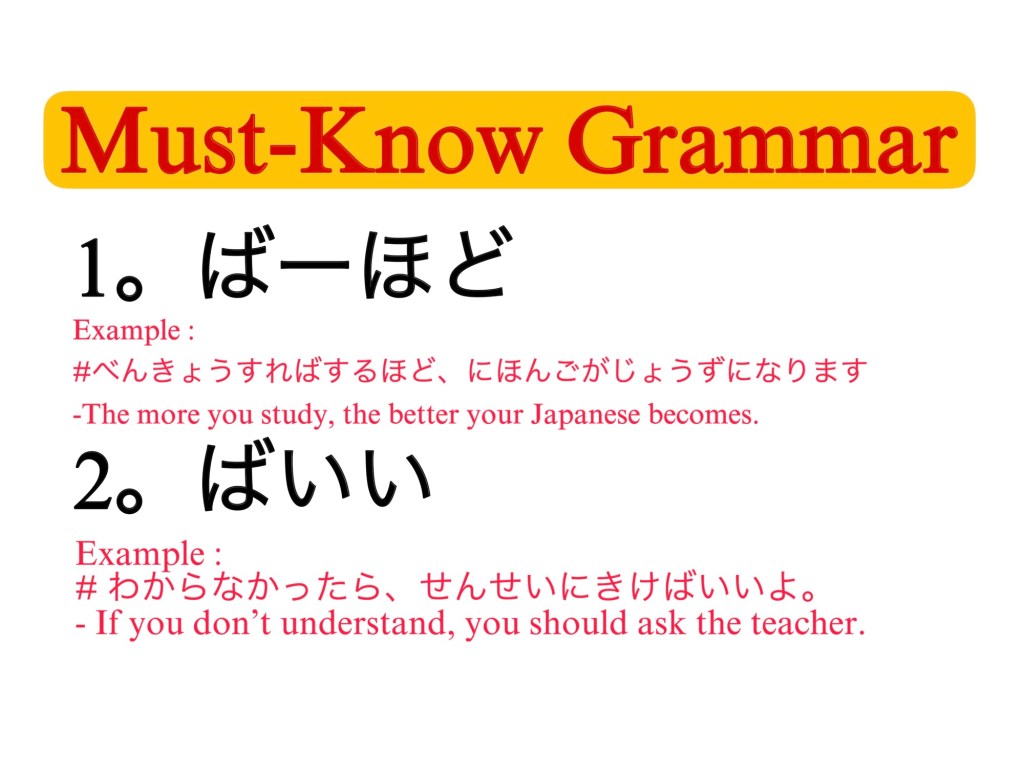
1. ば〜ほど: ‘The More…, The More…’”
The Japanese grammar pattern ば~ほど is used to express that “the more (A), the more (B).” It shows a proportional relationship between two things. The structure is typically: Verb (ば-form) + Verb/Adjective (dictionary form) + ほど. For example, 勉強
すればするほど、上手
になりますmeans “The more you study, the better you become.” It can also be used with adjectives: 安
ければ安
いほどいいmeans “The cheaper, the better.” This pattern is common in both written and spoken Japanese.
Examples :
年
を取
れば取
るほど、体
の大切
さが分
かりま す。
The older I get, the more I value my health.
経済
が成長
すればするほど貧富
の差
が広
がっていく。
The more developed the economy is, the bigger the disparity of wealth becomes.
この本
は読
めば読
むほど面白
くなる。
The more I read this book, the more interesting it gets.
高齢
であればあるほど転職
は厳
しくなる。
The older you get the harder it is to change jobs.
甘
いものを食
べれば食
べるほど太
っていく。
The more sweet stuff I eat the fatter I become.
日本語
は練習
すればするほど、上手
になります。
The more you practice Japanese, the better you become.
人
に親切
にすればするほど、自分
も幸
せになります。
The more kind you are to others, the happier you become.
考
えれば考
えるほど、わからなくなってきた。
The more I think about it, the more confused I get.
2. ばいい : You Should
The Japanese grammar pattern ばいい is used to give advice or suggest a course of action, and it roughly translates to “you should…” or “it would be good if…”. It is formed by taking the ば-form of a verb and adding いい (good). For example, 行
けばいい means “You should go” or “It would be good if you go.” It’s a soft, indirect way to suggest something and is commonly used in both casual and polite conversation.
Examples :
借
りたお金
は今後
5年
で帰
せばいいです。。
You can return the money you borrowed in the next 5 years.
後
で説明
すればいい。
You can explain later.
わざわざ来
る必要
はないです。電話
で連絡
すればいいです。
You don’t need to come all the way here. You should just give us a call.
こうして運
べばいい。
You should carry it this way.
ただ謝
ればいいというような問題
じゃない。
This is not a problem you can solve just by apologizing.
明日
の9時
に行
けばいいです。
You should come at 9 o’clock tomorrow.
どの出口
に出
ればいいの?
Which exit should I use?
話
したいことがあれば、どんどん話
せばいい。
If there’s something you want to say, you should just say it.
In this post, we explored two useful Japanese grammar patterns: ば〜ほど, which helps express proportional relationships like “the more…, the more…”, and ばいい, a simple way to give advice or suggestions. Both are commonly used in everyday conversation and are essential for expressing thoughts clearly and naturally in Japanese. Keep practicing these patterns in different situations, and you’ll soon be using them with confidence!
Do comment and subscribe for more updates like this informative post.
 Nihongo Focus
Leave a comment