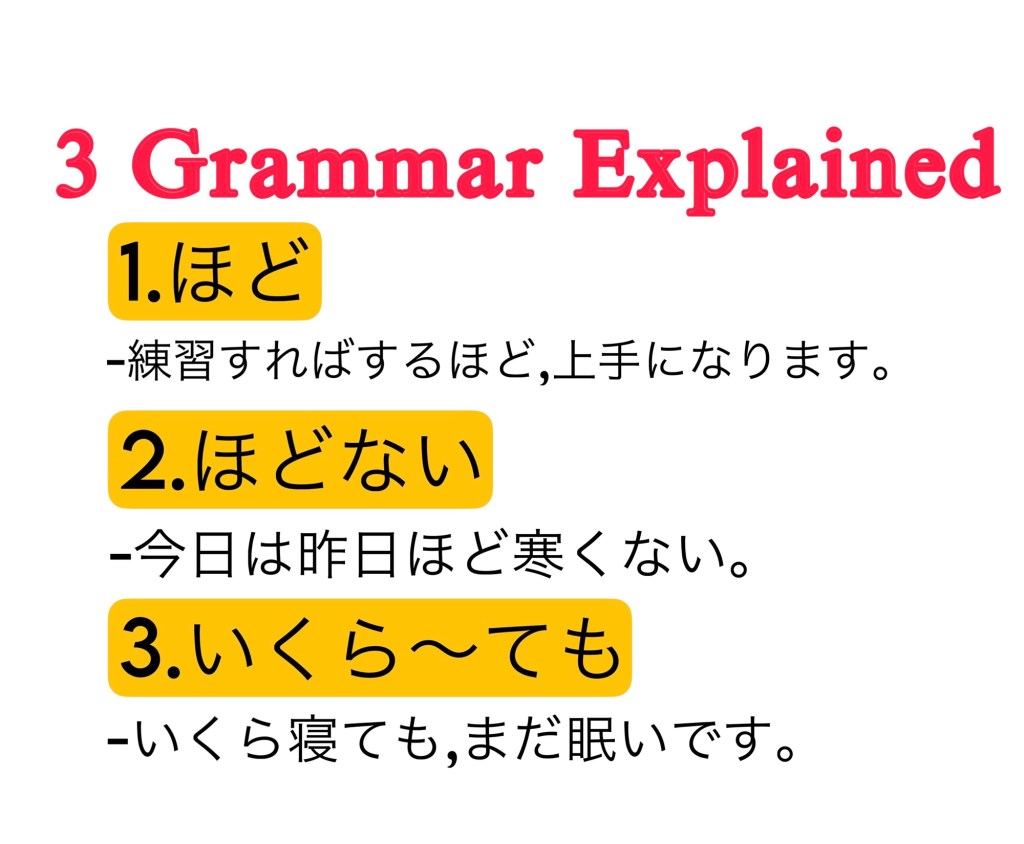
In this post, we’ll explore three essential grammar patterns that are frequently used in daily conversation and writing:
1.ほど (hodo), which shows extent or degree,
2.ほど〜ない (hodo ~ nai), which is used to make comparisons like “not as… as…”, and
3.いくら〜ても (ikura ~ temo), which expresses the idea of “no matter how…”.
First of all,
1.ほど (hodo): the more, to the extent that, so much… that
Meaning: to the extent that, so much… that; the more
Formation:
Verb-casual +ほど
Noun + ほど
いadj + ほど
なadj + なほど
In Japanese, the particle ほど is a versatile grammar point used to express degree, extent, or comparison. It often translates to phrases like “the more…,” “to the extent that…,” or “so much… that” in English.
The Japanese word ほど is used to talk about how much or how far something happens. You can think of it like saying:
“to the point that…”
“the more…, the more…”
or “about as much as…”
It’s a useful word that helps describe degree, level, or comparison in a sentence.
Example Sentences :-
彼
は泣
きたいほど疲
れている。
He’s so tired that he feels like crying.
(Literally: “Tired to the point he wants to cry.”)
練習
すればするほど、上手
になります。
The more you practice, the better you get.
今朝
は寒
くて、池
に氷
が張
るほどだった。
This morning it was so cold that the lake was frozen.
年
をとるほど体
が弱
くなる。
My body becomes weaker as I get older.
伝統的
なものは、古
いほど価値
がある。
The older traditional items are, the more value they have.
彼女
のことが好
きすぎて、会
えないほどつらい。
I love her so much that it’s painful not being able to see her.
今年
の日本語
能力
試験
はそれほど簡単
じゃなかった。
This year’s Japanese Language Proficiency Test wasn’t that easy.
今年
ほど雪
の降
った年
はなかった。
It snowed more this year than in any other year.
駅
に近
いほど家賃
が高
い。
The closer the house is to the station, the higher the rent.
飽
きるほど食
べた.
I ate so much that I don’t want to see anymore food.
わたしの部屋
は姉
の部屋
ほど広
くない。
My room is not as big as my elder sisters.
世
の中
には面白
くないことなんて山
ほどある。
The world’s full of boring things.
そんなのはべつに驚
くほどのことじゃないさ。
Really the thing seems to me simple enough.
選挙人
は人口
の多
い州
ほど多
く、人口
の少
ない州
ほど少
なくなります。
States with bigger populations have more electors. States with smaller populations have fewer.
寒
い日
は寒
いほど、ラーメンが美味
しい。
The colder the day, the better ramen tastes.
…
2.ほど~ない (hodo ~ nai): is not as…as
Meaning: is not as… as
Formation:
Noun 1 + ほど+ Noun 2+はない
Noun 1 + は + Noun 2+ ほど + adj-ない form
The Japanese grammar pattern ほど~ない is used to express comparisons, and it translates roughly to “not as… as…” in English.
structure:
A は B ほど~ない
→ A is not as ~ as B
Example sentences:
この映画
は前
の映画
ほど面白
くない。
This movie is not as interesting as the previous one.
日本語
は中国語
ほど難
しくない。
Japanese is not as difficult as Chinese.
今日
は昨日
ほど寒
くない。
Today is not as cold as yesterday.
東京
は大阪
ほどにぎやかではない。
Tokyo is not as lively as Osaka.
彼
ほど失礼
な人
はいません。
There’s no one as rude as him.
英語
の文法
は日本語
ほど難
しくありません。
English grammar is not as difficult as Japanese grammar.
試験
ほど嫌
なものはない。
I hate tests more than anything.
戦争
ほど残酷
で悲惨
なものはない。
There’s nothing more cruel and tragic than war.
このパソコンは新
しいモデルほど高
くない。
This computer is not as expensive as the new model.
今年
の合格率
は去年
ほど高
くありません。
This year’s pass rate is not as high as last year.
彼女
ほど優
しい人
はいない。
There’s no one as kind as her.
東京
ほど家賃
の高
いところはない。
No city has higher rent than Tokyo.
私
は母
ほど料理
が上手
ではありません。
I’m not as good at cooking as my mother.
今日
のテストは前回
ほど難
しくなかった。
Today’s test wasn’t as difficult as the last one.
…
3.いくら〜ても (ikura ~ temo): no matter how
Meaning: no matter how
In this post, you’ll learn how to use いくら〜ても, a simple way to say “no matter how…”
Formation:
いくら + Verb-てform + も
いくら + Noun + でも
いくら + いadj (remove い) + くても
いくら+ なadj + でも
Example sentences:
いくら安
くても、買
いたくない。
I don’t want to buy it no matter how cheap it is.
いくら走
っても追
いつけません。
No matter how much I run, I can’t catch up.
いくら好
きでもコーラーをたくさん飲
むと、身体
に悪
いですよ。
No matter how much you love Cocacola, it’s not good for your health if you drink too much.
いくら寝
ても、まだ眠
いです。
No matter how much I sleep, I’m still sleepy.
いくら調
べてもわからなかったので、先生
に聞
いた。
I could not understand no matter how much I studied so I asked my teacher.
彼女
はいくら頼
んでも聞
いてくれない。
No matter how much I beg she just won’t listen.
仕事
だから、いくら嫌
いでもやらなければならない。
It’s my job so I must do it no matter how much I hate it.
必要
なので、いくら高
くても買
います。
I need it so I’ll buy it now matter how expensive it is.
給料
がいくら上
がっても足
りない。
No matter how much of a raise I get, it still won’t be enough.
いくら食
べてもおなかがすきます。
No matter how much I eat, I get hungry.
いくら勉強
してもわかりません。
No matter how much I study, I don’t understand.
いくら待
っても彼
は来
ません。
No matter how long I wait, he doesn’t come.
いくら高
くても買
います。
No matter how expensive it is, I will buy it.
Now that you’ve learned how to use ほど, ほど〜ない, and いくら〜ても, try incorporating them into your own sentences and conversations. These grammar patterns may seem simple at first, but they are powerful tools for expressing comparisons, effort, and degree in Japanese. Keep practicing, and you’ll find yourself using them naturally in no time. がんばってくださいね!
Do Comment and Subscribe for the new informative post.
Thank you for reading this post.
 Nihongo Focus
Leave a comment