Are you starting your Japanese journey and preparing for the JLPT N5 exam? Congratulations! 🎉 In this post, we’ll explain 5 important grammar points that appear often in daily conversations and JLPT N5. These are easy, useful, and beginner-friendly. Let’s get started!
Lets study 5 Grammar !
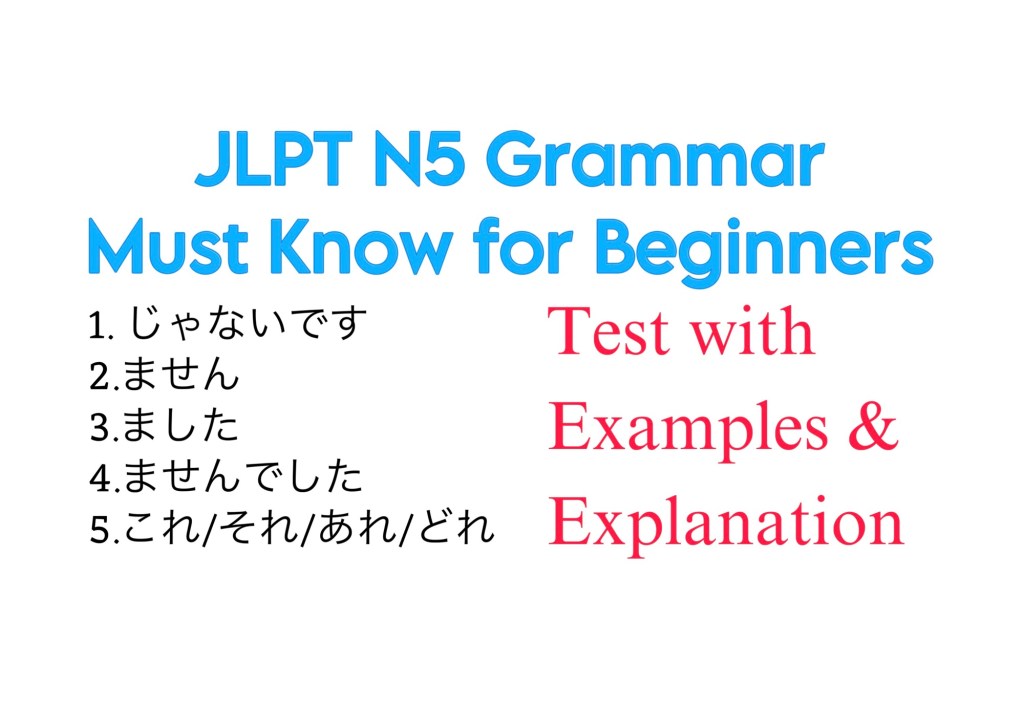
1.じゃないです – is not (negative of です)
2.ません – do not / does not (negative present/future verb form)
3.ました – did (polite past tense verb form)
4.ませんでした – did not do (polite negative past verb form)
5.これ – this (near the speaker) / それ – that (near the listener) / あれ – that over there (far from both) / どれ – which one? (used to ask a question)
1. じゃないです – “Is not” (Negative form of です)
💡 Meaning:
This is the negative of です. Use it when you want to say something is not something.
✅ Sentence structure:
Noun + じゃないです
📝 Examples:
- わたしはがくせいじゃないです。
(Watashi wa gakusei janai desu.)
→ I am not a student. - これはにほんのたべものじゃないです。
(Kore wa Nihon no tabemono janai desu.)
→ This is not Japanese food.
🗒 Note:
You can also say ではありません (more formal) instead of じゃないです.
2. ません – “Don’t / Doesn’t” (Negative form of a verb)
💡 Meaning:
Use ません when you want to say you don’t do something. It is the negative present/future tense of a verb.
✅ Sentence structure:
Verb (ます-form) + ません
📝 Examples:
- にほんごをべんきょうしません。
(Nihongo o benkyou shimasen.)
→ I don’t study Japanese. - コーヒーをのみません。
(Koohii o nomimasen.)
→ I don’t drink coffee.
🚀 Tip:
Start with verbs like たべます (eat), のみます (drink), いきます (go), and practice making them negative with ません!
3. ました – “Did” (Past form of a verb)
💡 Meaning:
Use ました to say you did something in the past. It is the polite past tense of a verb.
✅ Sentence structure:
Verb (ます-form) + ました
📝 Examples:
- きのう、にほんごをべんきょうしました。
(Kinou, nihongo o benkyou shimashita.)
→ I studied Japanese yesterday. - せんしゅう、えいがをみました。
(Senshuu, eiga o mimashita.)
→ I watched a movie last week.
🗒 Note:
Be sure to learn some common time words like きのう (yesterday), せんしゅう (last week), and use them with ました!
4. ませんでした – “Did not do” (Negative past form)
💡 Meaning:
This is the past negative form of a verb. Use it to say you did not do something.
✅ Sentence structure:
Verb (ます-form) + ませんでした
📝 Examples:
- きのう、にほんごをべんきょうしませんでした。
(Kinou, nihongo o benkyou shimasen deshita.)
→ I did not study Japanese yesterday. - パーティーにいきませんでした。
(Paatii ni ikimasen deshita.)
→ I did not go to the party.
🚀 Tip:
Practice switching between ました and ませんでした to master talking about the past.
5. これ・それ・あれ・どれ – This / That / That over there / Which one?
These are demonstrative pronouns, and they’re super common in daily Japanese.
| Word | Meaning | When to Use |
|---|---|---|
| これ | this | Close to the speaker |
| それ | that | Close to the listener |
| あれ | that (over there) | Far from both speaker and listener |
| どれ | which one? | Used when asking a question |
✅ Sentence structure:
これ / それ / あれ / どれ + は + noun + です。
📝 Examples:
- これはペンです。
(Kore wa pen desu.)
→ This is a pen. - それはわたしのかばんです。
(Sore wa watashi no kaban desu.)
→ That is my bag. - あれはがっこうです。
(Are wa gakkou desu.)
→ That over there is a school. - どれがあなたのくるまですか?
(Dore ga anata no kuruma desu ka?)
→ Which one is your car?
🧠 Memory trick:
- これ – ko is near me
- それ – so is near you
- あれ – a is over there
- どれ – do you know which one?
🌟 Practice Time!
Let’s combine these grammar points in short conversations.
🗣 Example 1:
A: これはにほんのえいがですか?
(Kore wa Nihon no eiga desu ka?)
→ Is this a Japanese movie?
B: いいえ、にほんのえいがじゃないです。アメリカのえいがです。
→ No, it’s not a Japanese movie. It’s an American movie.
🗣 Example 2:
A: きのう、えいがをみましたか?
(Kinou, eiga o mimashita ka?)
→ Did you watch a movie yesterday?
B: いいえ、みませんでした。
→ No, I did not watch it.
🗣 Example 3:
A: どれがあなたのかさですか?
(Dore ga anata no kasa desu ka?)
→ Which one is your umbrella?
B: それです。
→ It’s that one (near you).
🧩 Quick Quiz!
Choose the correct answer:
- わたしはせんせい( )。
A. じゃないです
B. でした - きのう、ほんを( )。
A. よみます
B. よみました - これはあなたのノート( )か?
A. どれ
B. です
Answers: 1 – A, 2 – B, 3 – B
🌈 Conclusion
You did it! 🎉 These grammar points are very useful in everyday conversations and super important for JLPT N5.
✅ What you learned:
- じゃないです – is not
- ません – don’t / doesn’t
- ました – did
- ませんでした – didn’t do
- これ・それ・あれ・どれ – this / that / which
Start using them in your daily Japanese practice! The more you use them, the more natural they will feel.
If this post was helpful, please leave a comment and subscribe!


Leave a Reply